

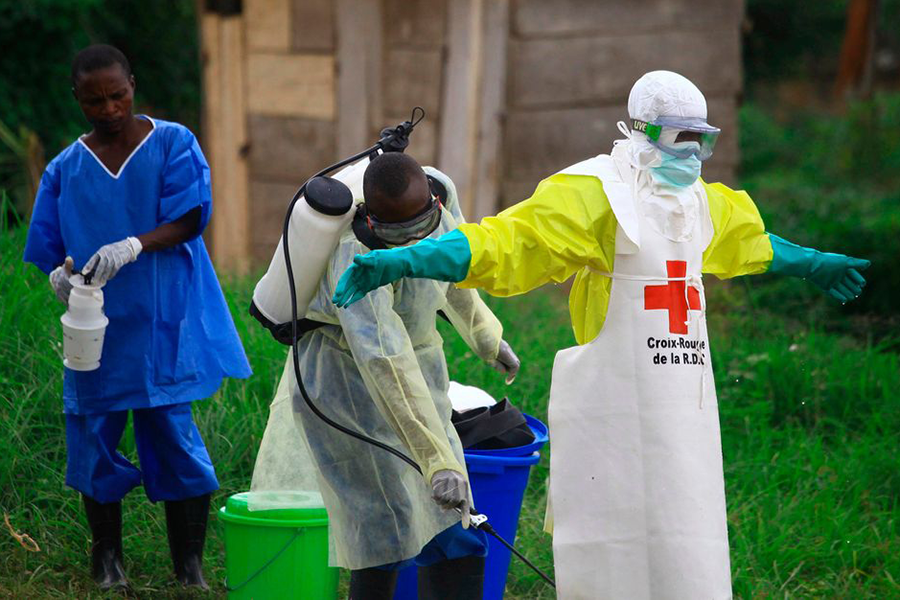
The Ministry of Health has confirmed an outbreak of Ebola Virus Disease caused by the Bundibugyo strain following the death of a 59-year-old Congolese national in Kampala.
In a statement issued on May 15, 2026, the ministry said the deceased was admitted at Kibuli Muslim Hospital on May 11 after presenting symptoms including respiratory distress, episodes of fever, epigastric pain, nausea, and difficulty passing urine.
“The case is of a 59-year-old Congolese male who was admitted at Kibuli Muslim Hospital on 11th May, 2026. He presented with respiratory distress, episodes of fevers, epigastric pain, nausea, fever and had challenges of passing urine,” the ministry said in the statement.
According to the ministry, the patient’s condition deteriorated while in admission and he later died on May 14 in the Intensive Care Unit with bleeding symptoms.
Health officials said the body was transported back to the Democratic Republic of the Congo at about 8pm on the same day.
The ministry said authorities were alerted by public health officials in DR Congo on May 15 regarding a suspected Ebola case, prompting officials to test a sample that had earlier been obtained from the deceased during treatment.
Laboratory analysis conducted at the Central Emergency Surveillance and Response Support laboratory in Wandegeya confirmed the presence of Ebola Bundibugyo virus.
“This is an imported case from DR Congo. The country has not yet confirmed a local case,” the ministry stated.
In response, the Ministry of Health said it had activated national response mechanisms, including the deployment of screening, surveillance, and rapid response teams at official and informal border points, particularly along the western border, major transit routes, and pilgrimage corridors.
Authorities have also activated emergency response systems in high-risk districts, including deployment of a mobile laboratory at Bwera Hospital, establishment of isolation facilities, intensified infection prevention and control measures, and public risk communication campaigns.
The ministry further revealed that one high-risk contact, described as a close relative of the deceased, had already been isolated while other contacts linked to the patient were being quarantined and monitored.
“The Ministry of Health remains fully engaged and will continue to provide timely updates while implementing all necessary measures to protect the people of Uganda,” the statement said.
Earlier on Friday, the Africa Centres for Disease Control and Prevention (Africa CDC) said confirmed around 246 cases and 65 deaths have been reported, mainly in the gold-mining towns of Mongwalu and Rwampara, in Ituri Province, eastern DR Congo.
Preliminary tests conducted at the Institut National de Recherche Biomédicale in Kinshasa detected the virus in 13 of 20 samples analysed, the health agency said.
The Africa CDC statement on Friday added that it was convening a meeting with DR Congo, neighbouring Uganda and South Sudan, and other international partners to discuss priorities, including response efforts and cross-border surveillance.
Ebola was first discovered in 1976 in what is now DR Congo, and is thought to have spread from bats. This is the 17th outbreak of the deadly viral disease in the country.
It is spread through direct contact with bodily fluids and through broken skin, causing severe bleeding and organ failure.
Early symptoms include fever, muscle pain, fatigue, headache and sore throat, and are followed by vomiting, diarrhoea, a rash and bleeding.
There is no proven cure for Ebola. According to the World Health Organisation (WHO), the average fatality rate is around 50%.
Uganda’s most recent Ebola outbreak before this one was the Sudan Ebola Virus Disease outbreak that was declared on January 30, 2025 and officially ended on April 26, 2025.
That outbreak:
- Was caused by the Sudan strain of Ebola, not the Bundibugyo strain.
- Began in Kampala after a male nurse tested positive and later died.
- Recorded 14 cases and four deaths, according to WHO and Uganda’s Ministry of Health.
Before the 2025 outbreak, Uganda’s previous major Ebola outbreak was the 2022–2023 Sudan strain outbreak centred in Mubende and Kassanda districts, which killed at least 55 people.
